Most people in Pakistan who are thinking about property investment start with residential. It feels familiar. You understand a house or an apartment in a way that feels personal. You can picture someone living in it. You know roughly what it should cost. Residential property has been the default investment choice for Pakistani families for generations.
But the conversation is shifting. More investors in Lahore are now seriously comparing commercial property investment against residential before making a decision. And in many cases, especially in 2026, the numbers coming out of commercial property are difficult to ignore.
This guide looks at both options honestly. It covers rental yields, capital appreciation, risks, tenant dynamics, and the specific market conditions in Lahore right now. By the end, you’ll have a clear picture of which type of investment suits your situation and where the better opportunity currently sits.
The Basic Difference Between Commercial and Residential Investment
Before getting into the numbers, it helps to be clear about what each type of investment actually involves.
Residential property means buying a house, apartment, or flat with the intention of renting it out or selling it later at a profit. The tenant is typically a family or individual. Leases are usually short, often month to month or one year at a time. The landlord has significant legal obligations and the tenant has strong protections under Pakistani law.
Commercial property means buying a shop, office, plaza unit, or commercial floor for business use. The tenant is a company or business. Leases are typically longer, often two to five years. The tenant usually maintains the space and sometimes even improves it. The landlord’s day-to-day involvement is generally lower.
Both types can generate rental income and both can appreciate over time. The difference is in how they perform, who your tenants are, and what kind of management they require from you as an investor.
Rental Yields: Commercial vs Residential in Lahore
This is where the two investment types start to separate quite clearly.
Residential property in Lahore typically generates a rental yield of around 3 to 5 percent per year on market value. A house worth PKR 30 million in a decent area of Lahore will usually rent for somewhere between PKR 75,000 and PKR 120,000 per month. That’s a reasonable return, but not exceptional. And from that income, the landlord typically covers maintenance costs, property tax, and the periods when the unit sits vacant between tenants.
Commercial property in Lahore, especially in high-demand zones, tends to generate yields of 6 to 10 percent per year. “Our overview of commercial real estate in Lahore.
covers how different zones compare on rental returns. An office or shop unit in a well-located modern building can command rents that are significantly higher relative to the purchase price. The tenant base is also more stable. A business that signs a two or three year lease and invests in fitting out the space is unlikely to leave at short notice. That consistency makes income from commercial property much more predictable.
For investors focused on cash flow, the difference in yield between the two asset classes is meaningful. Commercial property investment in Lahore simply generates more income per rupee invested in most scenarios.
Capital Appreciation: Which Grows Faster?
Rental income is one part of the equation. The other is how much the property itself grows in value over time.
Residential property in Lahore has historically delivered solid capital appreciation, particularly in established neighborhoods and planned housing societies. Areas like DHA, Bahria Town, and Model Town have seen consistent growth over the past decade. But much of this growth has already happened. Entry prices in the most desirable residential zones are high, which limits how much further appreciation is available for someone buying today.
Commercial property in Lahore’s growing zones tells a different story. Areas like Johar Town, which are still in the middle of their commercial development cycle rather than at the end of it, offer better appreciation potential for buyers entering now. Investors who bought commercial units in Johar Town three to five years ago have seen values move significantly. The zone is still growing, which means there is still meaningful upside for buyers coming in at the current stage. Investors who bought commercial units in Johar Town have seen values move significantly.
The rule of thumb in property investment is that you make more money entering a zone that is developing than entering one that has already fully developed. On this measure, commercial property in active growth zones currently offers better capital appreciation potential than residential property in established Lahore neighborhoods.
Tenant Quality and Lease Stability
This is a factor that doesn’t get enough attention when people compare residential and commercial investment.
Residential tenants in Pakistan are often short-term. Families move for schools, jobs, marriages, and any number of personal reasons. A landlord with a residential property can realistically expect to find new tenants every one to two years. Each transition comes with a gap period, agency fees, potential repair costs, and the time spent finding a suitable replacement.
Commercial tenants behave very differently. A software house, IT company, or professional services firm that sets up in a commercial office invests time and money into that space. They install equipment, fit out the interior, set up their connectivity, and build their team around a specific address. Moving is disruptive and expensive for them. This means they stay longer, treat the space better, and rarely miss payments.
From an investor’s perspective, a commercial tenant on a two to three year lease is far more valuable than a residential tenant on a rolling monthly arrangement. The income is more reliable, the vacancy risk is lower, and the landlord’s involvement in day-to-day management is minimal compared to managing a residential unit.
Risks: Where Each Type of Investment Can Go Wrong
Every investment has risks. Being honest about them is part of making a good decision.
Risks With Residential Property Investment in Lahore
The biggest risk in residential investment is vacancy. If a unit sits empty for two or three months between tenants, that’s a significant chunk of the year’s income gone. Residential tenants also have stronger legal protections in Pakistan, which can make it difficult to remove a non-paying tenant quickly. Maintenance costs for residential property are ongoing and often unpredictable. A major plumbing issue, a roof problem, or electrical work can eat into several months of rental income in one go.
Residential property is also more sensitive to oversupply. Lahore has seen significant residential construction over the past decade, and in some areas the supply of houses and apartments has grown faster than demand. This can put downward pressure on rents and slow appreciation in those specific zones.
Risks With Commercial Property Investment in Lahore
Commercial property isn’t without risk either. The biggest commercial risk is choosing the wrong location or the wrong type of unit. A shop in a poorly planned building with low footfall, or an office in an area where businesses don’t want to locate, can sit vacant for extended periods. This is why project selection and location due diligence matter so much more with commercial property than with residential.
Commercial property also requires a larger upfront investment in most cases. The ticket size is higher, which means the stakes of a poor decision are higher too. Investors who don’t do proper research on the developer’s track record, the building’s infrastructure quality, and the zone’s commercial demand can end up with an asset that underperforms.
The way to manage commercial investment risk is to choose projects in zones with demonstrated demand, from developers with completed track records, in buildings that are actually designed for the kind of tenants they’re trying to attract. Understanding what to look for in a commercial project is covered in our guide on where to invest in Lahore real estate in 2026.
Management Effort: Which Requires More of Your Time?
This is something first-time investors often underestimate.
Residential property in Lahore requires ongoing management. Tenants call about maintenance issues. Repairs need to be organized. Lease renewals need to be negotiated. Utility bills and property taxes need to be managed. If you have multiple residential units, this can become a part-time job. Many landlords end up hiring a property manager, which adds to costs and reduces net yield.
Commercial property, especially in a professionally managed building, is considerably lower maintenance. The tenant manages the interior. The building management handles common areas, security, and infrastructure. The landlord collects rent and reviews lease terms at renewal. For investors who want passive income without ongoing operational involvement, commercial property is the more practical option.
The 2026 Market in Lahore: Why Commercial Is Winning Right Now
Lahore’s residential market in 2026 is facing some specific headwinds. Prices in established zones have risen to a point where yields have compressed. In DHA and Bahria Town, entry prices are high enough that the rental return on a new purchase is often below 4 percent. The appreciation upside in these areas is also more limited because they are mature markets.
The commercial market in Lahore is in a different position. Demand from the city’s IT sector, startup ecosystem, and expanding corporate businesses is growing consistently. There is a genuine shortage of quality, purpose-built commercial office space in Lahore’s prime zones. Buildings that are well-located and properly equipped are attracting strong tenant interest and commanding rents that support solid yields.
Johar Town specifically stands out. It’s in the middle of its commercial development cycle, not at the end of it. New businesses are moving into the area. Expo Center Lahore generates consistent professional footfall throughout the year. Infrastructure in the zone is improving. The zone continues to attract new businesses and commercial projects which keeps demand for quality office space consistently active. You can read more about why Johar Town is developing into Lahore’s next major IT and commercial hub in our detailed breakdown.
Who Should Consider Commercial Property Investment in Lahore?
Commercial property investment isn’t the right fit for every investor. But for certain profiles, it’s clearly the better option.
If you already own residential property and are looking to diversify your portfolio, commercial property in a growing zone gives you exposure to a different asset class with different yield dynamics. It balances the lower-yield, lower-management residential asset with a higher-yield, more passive commercial one.
If you’re a first-time investor with enough capital to enter a quality commercial project, the numbers in Lahore’s current market favor commercial over residential for both income and appreciation. The entry price per square foot in well-located office projects is competitive, and the payment plans available from quality developers make it accessible without requiring full upfront capital.
If you run a business and are currently renting office space, buying your own office converts a monthly expense into equity. You stop paying someone else’s mortgage and start building your own asset. This applies to software houses, IT companies, consulting firms, and any professional business that expects to stay in one location for three or more years.
HiTech Tower: A Commercial Investment Worth Considering in Johar Town
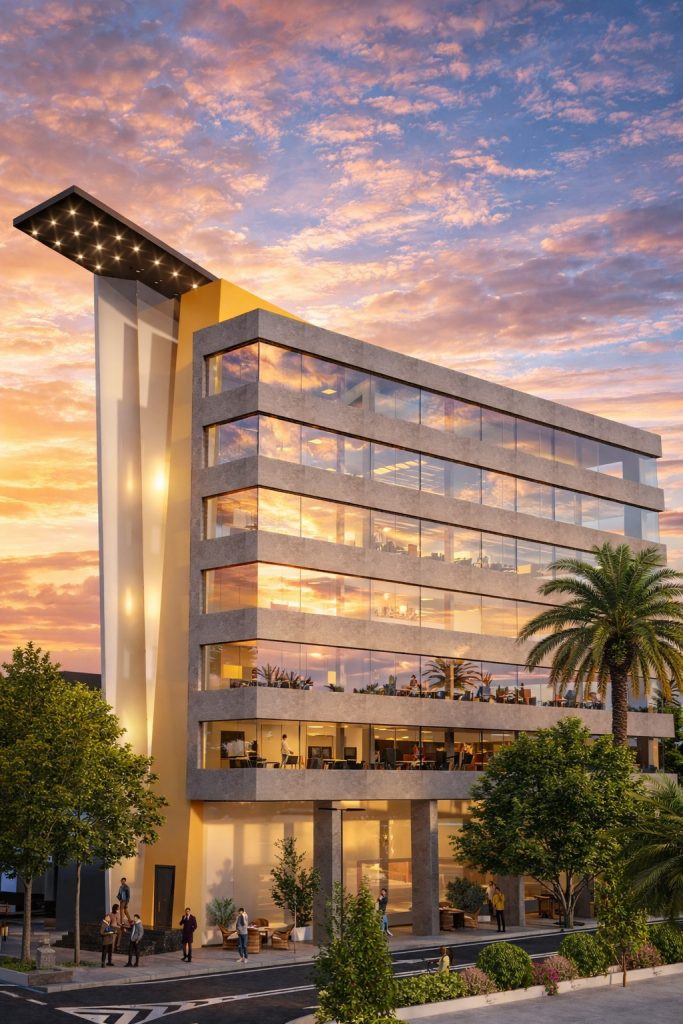
For investors specifically looking at commercial property investment in Lahore’s Johar Town zone, HiTech Tower is one of the current projects that directly addresses the criteria covered in this blog.
The project is located directly facing Expo Center Lahore on Nazria-e-Pakistan Avenue – one of the most commercially active addresses in the area. It offers office units across the basement and floors 1 through 6, with unit sizes ranging from 380 square feet to 1,007 square feet. Ground floor shops and brand outlets are also available for retail investors. Each unit is plug and play ready, meaning tenants can move in and begin operations without a lengthy fit-out process. This directly reduces vacancy risk for investors.
Office floors 1 to 6 are priced at PKR 40,000 per square foot. Basement offices are at PKR 35,000 per square foot. Ground floor shops are priced at PKR 100,000 per square foot. The payment plan runs over 30 months, starting with a 20% booking amount, monthly installments, a balloon payment every 6 months, and 20% at possession. This structure makes it accessible for investors who want to enter without committing the full amount upfront.
The location facing Expo Center, the plug and play infrastructure, and the purpose-built commercial design all work together to make this the kind of project that attracts quality tenants quickly – which is exactly what investors should be looking for in a commercial property in Lahore. You can find the full floor plan breakdown and payment details in our dedicated guide on office space in Johar Town Lahore.
FAQs
For most investors focused on rental yield and passive income, commercial property in a well-chosen location in Lahore currently outperforms residential. Commercial yields of 6 to 10 percent compare favorably to residential yields of 3 to 5 percent, and commercial tenants tend to sign longer leases and stay more reliably.
Commercial property in prime Lahore zones - particularly purpose-built office and retail units in areas like Johar Town - typically generates rental yields between 6 and 10 percent per year. This varies depending on location, build quality, tenant type, and how well the unit is positioned within the building.
The main risks are choosing a poorly located project, buying from a developer without a proven track record, and selecting a unit in a building that doesn't match tenant requirements. These risks are manageable with proper research. Vacancy in commercial property is a real risk but significantly lower in zones with active business demand like Johar Town.
Johar Town is still in the active development phase of its commercial cycle, which means better appreciation potential compared to fully mature zones like Gulberg. Proximity to Expo Center generates consistent professional footfall. New purpose-built commercial projects in the area are attracting IT companies, software houses, and corporate businesses at a growing rate. Entry prices are more competitive than Gulberg while offering a comparable professional environment.
Yes, and in many cases it's the smarter financial decision. For businesses with stable revenue and a clear location preference for the next three or more years, buying converts monthly rent into equity. Payment plans available from quality developers in Lahore make it possible to own commercial property without paying the full amount upfront, which makes it accessible for growing businesses as well as pure investors.