Anyone budgeting for property tax on commercial property in Lahore this year needs to look past the sale price on the brochure. Withholding tax, provincial stamp duty, and registration fees can add a meaningful amount on top of whatever a shop or office is listed for.
This guide breaks down what buyers and sellers of commercial property in Lahore actually pay in 2026. It covers where the rates come from, and why the number on your bank challan is often higher than the number you expected.
As with any tax topic, rates change with each Finance Act. Treat this as a starting framework, not a final answer. Confirm current figures with a tax consultant or the relevant department before you transfer any payment.
The Two Numbers That Catch Most Buyers Off Guard
The first surprise for most first-time commercial buyers is simple. Federal withholding tax on property is calculated on the FBR-notified valuation of the area, not on the price actually written into the sale agreement.
The second surprise matters just as much. Whether you are listed as a tax filer or a non-filer changes the rate substantially, sometimes by more than three times.
Both of these apply before you even get to the provincial stamp duty and registration charges that Punjab adds on top. Together, they are why the final cost of a commercial unit is rarely the headline price alone.
Federal Withholding Tax: Sections 236C and 236K
Property tax on commercial property in Lahore starts at the federal level with two withholding tax sections. They apply on opposite sides of the same transaction.
Section 236C is advance tax deducted from the seller at the time of transfer. Section 236K is advance tax collected from the buyer at the time of purchase.
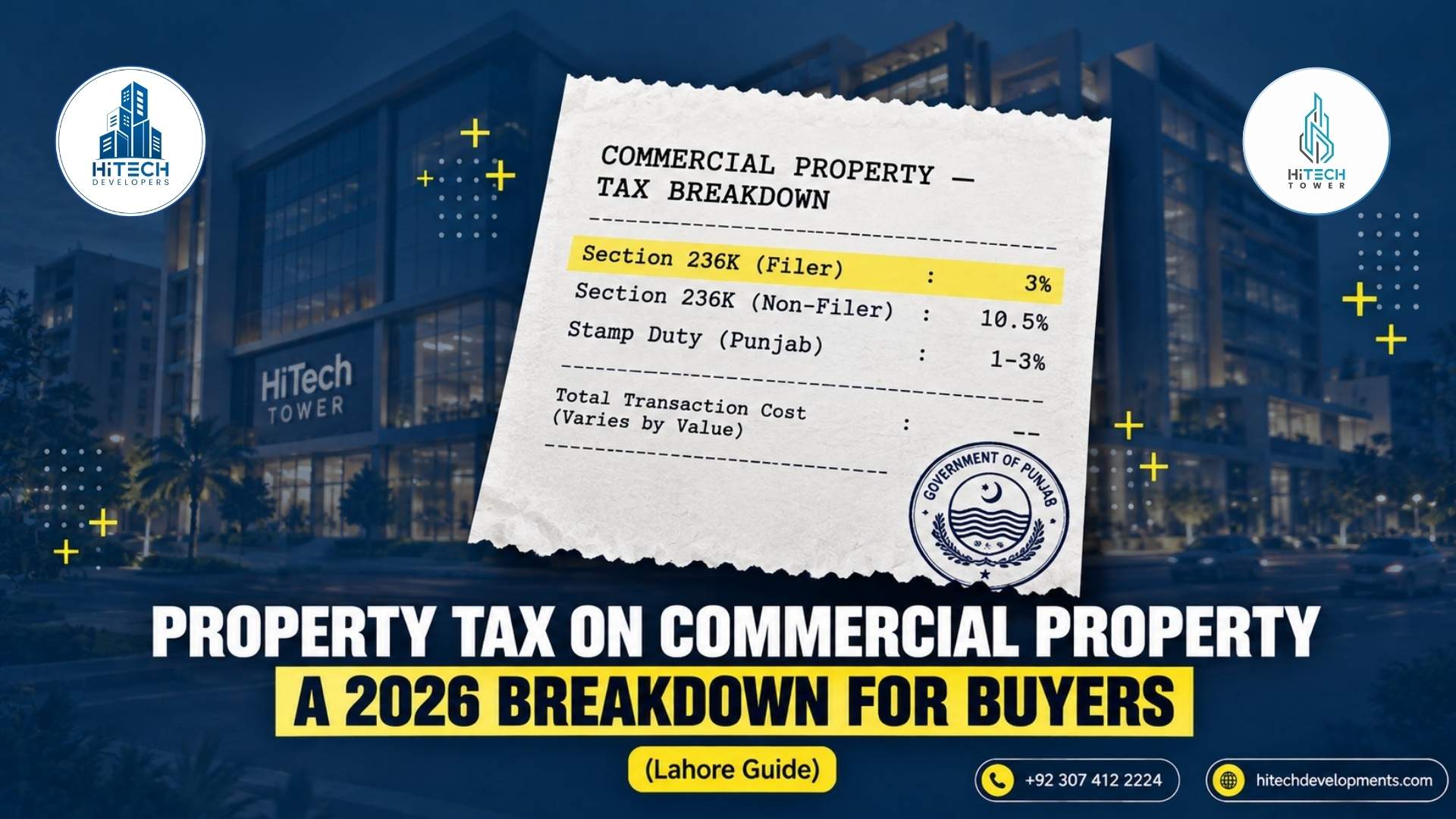
As of the 2026-27 tax year, active filers pay 3 percent under both sections. Non-filers pay a noticeably higher rate: 10 percent under Section 236C for sellers, and 10.5 percent under Section 236K for buyers.
Both sections are calculated on the FBR-notified valuation rather than the declared sale price. It is worth checking that valuation figure before you finalize a budget, since it can differ from the market price quoted by the seller or developer.
- Section 236C (seller, advance tax on sale): 3 percent for filers, 10 percent for non-filers.
- Section 236K (buyer, advance tax on purchase): 3 percent for filers, 10.5 percent for non-filers.
- Both are calculated on the FBR-notified valuation of the property, not the price written in the sale agreement.
- Becoming an active tax filer before a transaction is one of the more straightforward ways to reduce this cost on both sides of a deal.
A Quick Worked Example: Filer vs Non-Filer on a Johar Town Shop
Numbers make this easier to picture than percentages alone. Take a ground floor shop at HiTech Tower, priced at PKR 100,000 per square foot. A 223 square foot unit works out to roughly PKR 22.3 million before tax.
As a filer, Section 236K advance tax at 3 percent comes to approximately PKR 669,000. As a non-filer, the same purchase is taxed at 10.5 percent, which comes to roughly PKR 2.34 million.
That is a difference of more than PKR 1.6 million on a single shop, from filer status alone, before stamp duty or registration fees are even added. It is one of the clearest reasons to sort out your filer status early in the process, not after you have already booked a unit.
- Filer (3 percent): approximately PKR 669,000 in Section 236K advance tax on a PKR 22.3 million shop.
- Non-filer (10.5 percent): approximately PKR 2.34 million in Section 236K advance tax on the same shop.
- The gap: roughly PKR 1.67 million, before any stamp duty or registration fee is added on top.
Where Section 7E Currently Stands
Section 7E is the deemed-income tax that applied to certain high-value immovable property. It has been a moving target across recent Finance Acts.
Some guidance describes it as still applicable above a certain FBR valuation threshold. More recent commentary describes it as abolished for the 2026 tax year.
This specific section has changed frequently. That makes it exactly the kind of detail where a quick check with a tax consultant or the FBR is worth more than any blog post, including this one.
Punjab Stamp Duty and Registration Costs for Commercial Property in Lahore
On top of federal withholding tax, Punjab charges its own stamp duty on property transfers. It currently ranges from roughly 1 to 3 percent, depending on the property type and the zone it falls in.
Commercial property is typically assessed differently from residential property. Registration fees are charged separately by the province, on top of the federal withholding tax.
Both stamp duty and registration fees are paid at the time the sale deed is registered, not at booking. That timing catches some buyers off guard if they have only budgeted for the booking and installment amounts.
Because these provincial rates are set by notification, they can be revised at any time.
The most reliable way to confirm the exact percentage for a specific Lahore zone is to check directly with Punjab’s Excise and Taxation Department.
Confirm current federal withholding tax rates the same way, against the Federal Board of Revenue. A fixed number in any guide, including this one, can be out of date by the time you transact.
Property Tax on Commercial Property in Lahore: Building It Into Your Actual Budget
The practical takeaway for anyone evaluating property tax on commercial property in Lahore is simple. Build these costs into your budget from the start, not as an afterthought at possession.
On a unit priced at PKR 100,000 per square foot, a combined withholding tax and stamp duty burden can run 5 to 15 percent. That is not a small line item. The exact figure depends on filer status and zone, as the worked example above shows.
Buyers evaluating a staged payment plan, such as the 30-month structure available on HiTech Tower’s office and retail units, should factor these charges in at the possession stage specifically. That is typically when the transfer and registration steps, and their associated tax obligations, are triggered.
This overlaps closely with the documentation and legal checklist we have published separately for commercial buyers in Lahore, which covers title verification and registered agreements alongside these tax obligations.
If you are budgeting for property tax on commercial property in Lahore alongside the purchase price, the HiTech Developers team can walk you through current pricing and payment plan details for HiTech Tower. Reach out at +92 307 412 2224 or he**@****************ts.com.
FAQs
For the 2026-27 tax year, active filers pay 3 percent under both Section 236C (seller) and Section 236K (buyer). Non-filers pay 10 percent under Section 236C and 10.5 percent under Section 236K. Both are calculated on the FBR-notified valuation, not the declared sale price.
Yes, significantly. Non-filer rates run more than three times higher than filer rates on the buyer side. Becoming an active filer before a transaction is one of the most direct ways to reduce this cost.
On a PKR 22.3 million ground floor shop, a filer pays roughly PKR 669,000 in Section 236K tax. A non-filer pays roughly PKR 2.34 million for the same unit, a difference of more than PKR 1.6 million.
Yes, it is separate. Punjab stamp duty currently runs roughly 1 to 3 percent depending on property type and zone. Registration fees come on top of that, and both are separate again from the federal withholding tax under Sections 236C and 236K.
This has changed across recent Finance Acts and sources currently disagree on its status. Confirm directly with a tax consultant or the FBR before assuming either way.
They are triggered at the time of transfer and registration of the sale deed. For a staged payment plan, that typically lines up with the possession stage rather than the initial booking.
Federal withholding tax rates are published by the Federal Board of Revenue, and Punjab-specific stamp duty and registration rates are published by the province’s Excise and Taxation Department. Both should be checked directly since rates are revised periodically.